
DJI Power 500
#31 in Mid-sizeFull review
A compact, quiet 512 Wh LFP station that suits DJI drone and camera users who mostly charge from the wall; buyers who want built-in solar input or a 12V socket should look elsewhere.
Amazon DJI $299$299
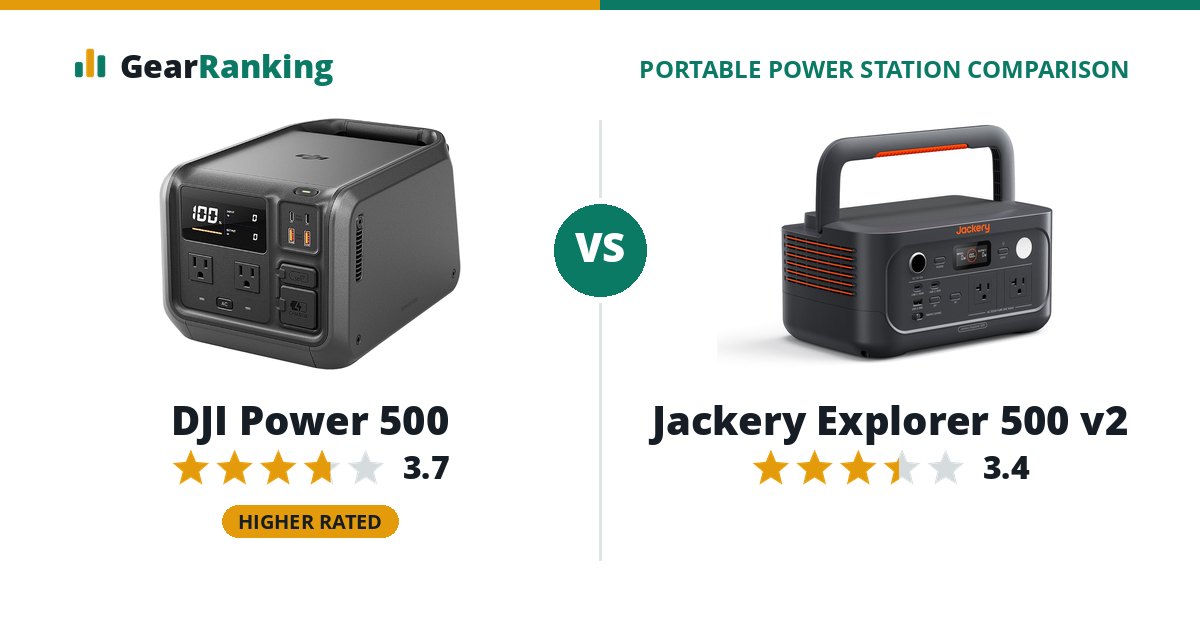
The DJI Power 500 is the better portable power station overall, rated 3.7 to 3.4. The DJI Power 500 leads on AC output, value and solar input. The Jackery Explorer 500 v2 wins on portability. The DJI Power 500 costs $60 less ($299 vs $359).
A compact, quiet 512 Wh LFP station that suits DJI drone and camera users who mostly charge from the wall; buyers who want built-in solar input or a 12V socket should look elsewhere.
Amazon DJI $299A small, light LiFePO4 station for camping, CPAP and keeping a router up through short outages.
Amazon $359Prices were last checked October 20, 2026 and are subject to change; the price and availability shown by the retailer at the time of purchase apply.
Each factor is scored 0-100 against the same fixed reference points for every mid-size portable power station; a clear win is highlighted. How we rank explains each one.
| Factor weight | DJI Power 500 | Jackery Explorer 500 v2 |
|---|---|---|
| Overall rating | 3.7/5 | 3.4/5 |
| Value 25% | 69 $0.58 per rated Wh | 53 $0.70 per rated Wh |
| Tested capacity 15% | 41 79% of rated capacity delivered (1 test) | 50 not yet independently tested (neutral score used) |
| Battery life 15% | 100 LiFePO4, 4,000 cycles, 5-year warranty | 100 LiFePO4, 6,000 cycles, 5-year warranty |
| AC output 15% | 44 1,000 W continuous AC | 0 500 W continuous AC |
| Charging speed 10% | 89 0-100% on AC in 1 h 10 min | 50 full AC charge time not published (neutral score used) |
| Portability 10% | 46 70 Wh per kg (16.1 lb (7.3 kg)) | 81 90 Wh per kg (12.6 lb (5.7 kg)) |
| Solar input 5% | 51 300 W max solar input | 28 200 W max solar input |
| Features 5% | 55 UPS (20 ms), 100 W USB-C | 55 UPS (10 ms), 100 W USB-C |
| Tested by | Usable AC energy | Of rated | Conditions |
|---|---|---|---|
| The Solar Lab | - | 79% | 905W load ran 27 minutes against about 33 minutes expected from the rated 512 Wh. AC recharge from empty took 83 minutes. |
No independent test published yet.
| DJI Power 500 | Jackery Explorer 500 v2 | |
|---|---|---|
| Battery | ||
| Rated capacity | 512 Wh | 512 Wh |
| Tested usable capacity | 404 Wh (79%) | - |
| Chemistry | LiFePO4 | LiFePO4 |
| Cycle life | 4,000 to 70%+ | 6,000 to 70%+ |
| Expandable | No | No |
| Output | ||
| AC output | 1,000 W | 500 W (1,000 W surge) |
| AC outlets | 2 total | 2 total |
| 120V 15A outlets (NEMA 5-15R) | 2 | - |
| 120V 20A outlets (NEMA 5-20R) | - | 2 |
| USB-C ports | 2 (up to 100 W each) | 2 (up to 100 W each) |
| USB-A ports | 2 | 1 |
| 12 V car outlet | No | Yes |
| DC5521 ports | 0 | - |
| UPS / pass-through | Yes (20 ms switchover) | Yes (10 ms switchover) |
| Charging | ||
| Full AC charge time | 1 h 10 min (0-80% in 50 min (manufacturer); The Solar Lab measured 83 min to full) | - |
| Max solar input | 300 W | 200 W |
| Solar input voltage | - | 16-60V (1 x DC8020 input, shared with car input) |
| Build | ||
| Weight | 16.1 lb (7.3 kg) | 12.6 lb (5.7 kg) |
| Dimensions | 305 x 207 x 177 mm | 31.1 x 20.5 x 15.7 cm |
| Warranty | 5 years | 5 years |
