
Goal Zero Yeti 300
#18 in SmallFull review
For campers and tailgaters who want a small, weather-resistant battery for phones, lights, laptops and a CPAP, and who don’t need to run anything over 350W.
Amazon $349.95$349.95
The Goal Zero Yeti 300 is the better portable power station overall, rated 3.5 to 3.4. The Goal Zero Yeti 300 leads on battery life, charging speed and features. The EnginStar R300 wins on value and portability. The EnginStar R300 costs $199.96 less ($149.99 vs $349.95).
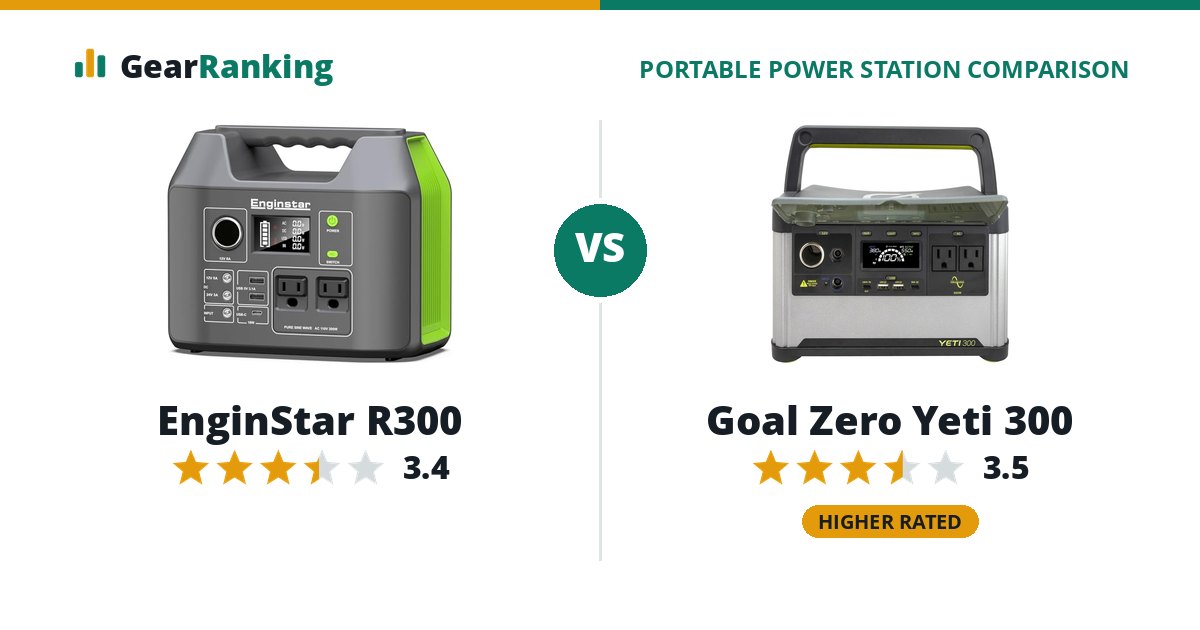
For campers and tailgaters who want a small, weather-resistant battery for phones, lights, laptops and a CPAP, and who don’t need to run anything over 350W.
Amazon $349.95A cheap, light 296Wh station for phones, cameras, CPAP and small camping loads. Buyers who will cycle it often should pay a little more for a LiFePO4 model with a longer warranty.
Amazon $149.99Prices were last checked October 22, 2026 and are subject to change; the price and availability shown by the retailer at the time of purchase apply.
Each factor is scored 0-100 against the same fixed reference points for every small portable power station; a clear win is highlighted. How we rank explains each one.
| Factor weight | Goal Zero Yeti 300 | EnginStar R300 |
|---|---|---|
| Overall rating | 3.5/5 | 3.4/5 |
| Value 25% | 37 $1.18 per rated Wh | 95 $0.51 per rated Wh |
| Tested capacity 15% | 50 not yet independently tested (neutral score used) | 50 not yet independently tested (neutral score used) |
| Battery life 15% | 100 LiFePO4, 4,000 cycles, 5-year warranty | 19 Lithium-ion, 1,000 cycles, 1-year warranty |
| AC output 15% | 51 350 W continuous AC | 41 300 W continuous AC |
| Charging speed 10% | 100 0-100% on AC in 50 min | 0 0-100% on AC in 7 h |
| Portability 10% | 5 48 Wh per kg (13.7 lb (6.2 kg)) | 100 100 Wh per kg (6.5 lb (3 kg)) |
| Solar input 5% | 62 200 W max solar input | 50 solar input not published (neutral score used) |
| Features 5% | 75 UPS (20 ms), 100 W USB-C, app | 0 no UPS, expansion or app |
| Goal Zero Yeti 300 | EnginStar R300 | |
|---|---|---|
| Battery | ||
| Rated capacity | 297 Wh | 296 Wh |
| Chemistry | LiFePO4 | Lithium-ion |
| Cycle life | 4,000 to 80% | 1,000 >1000 cycles per the manual; end-of-life capacity not stated |
| Expandable | No | - |
| Output | ||
| AC output | 350 W (600 W surge) | 300 W |
| AC outlets | 2 total | 2 total |
| 120V 15A outlets (NEMA 5-15R) | 2 | 2 |
| AC waveform | Pure sine wave | Pure sine wave |
| USB-C ports | 2 (up to 100 W each) | 1 (18 W) |
| USB-A ports | 2 | 2 |
| 12 V car outlet | Yes | Yes |
| DC5521 ports | 0 | 2 |
| UPS / pass-through | Yes (20 ms switchover) | - |
| Charging | ||
| AC charging | 420 W | 65 W |
| Full AC charge time | 50 min (Fast mode, 420W (manufacturer); ships in 140W low mode, about 3 h) | 7 h (About 7 hours per the manual and the B09SHB84J2 listing; a listing image says 5-7 hr. Another EnginStar listing (B0FJD7LCY4) claims 80% in 2 hours, which doesn't fit a 65W input and isn't used here.) |
| Max solar input | 200 W | - |
| Solar input voltage | 8mm 12.3-28V, up to 10A | 12-25V |
| Car charging | 120 W | - |
| Build | ||
| Weight | 13.7 lb (6.2 kg) | 6.5 lb (3 kg) |
| Dimensions | 11.3 x 7.7 x 6.7 in | 9.06 x 7.64 x 5.51 in |
| App | Goal Zero Power app | - |
| Warranty | 5 years | 1 years |
