
Seauto SAT20 Pro
#17 in CordlessFull review
A tracked, sonar-guided full-pool robot at a low price for mid-size and large in-ground pools. Buyers who want scheduling or a longer warranty should look at WYBOT.
Amazon $259.99$259.99
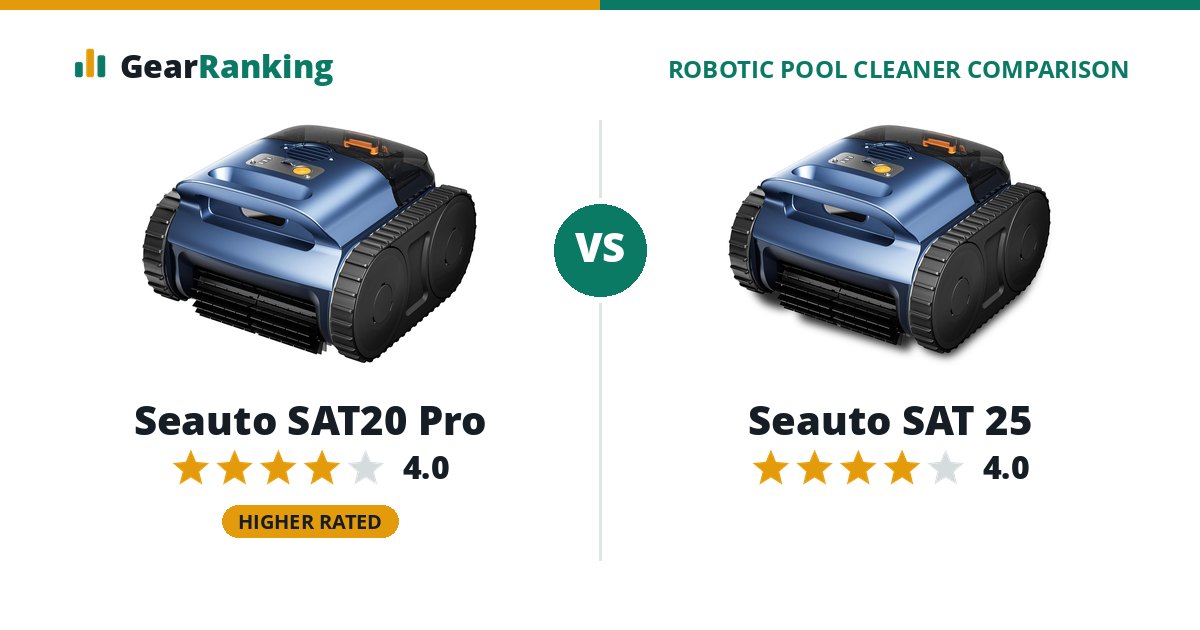
The Seauto SAT20 Pro and the Seauto SAT 25 are evenly matched, rated 4.0 and 4.0. The Seauto SAT20 Pro costs $10 less ($259.99 vs $269.99).
A tracked, sonar-guided full-pool robot at a low price for mid-size and large in-ground pools. Buyers who want scheduling or a longer warranty should look at WYBOT.
Amazon $259.99A low-cost, sonar-guided cordless robot for in-ground and above-ground pools up to about 2,150 sq ft that need floor, wall and waterline cleaning. Pools with fine silt, raised drains or sharp steps need a different robot.
Amazon $269.99Prices were last checked October 22, 2026 and are subject to change; the price and availability shown by the retailer at the time of purchase apply.
Each factor is scored 0-100 against the same fixed reference points for every cordless robotic pool cleaner; a clear win is highlighted. How we rank explains each one.
| Factor weight | Seauto SAT20 Pro | Seauto SAT 25 |
|---|---|---|
| Overall rating | 4.0/5 | 4.0/5 |
| Value 25% | 98 $260 | 97 $270 |
| Cleaning 25% | 85 Floor, walls and waterline | 85 Floor, walls and waterline |
| Navigation 15% | 75 Ultrasonic | 75 Ultrasonic |
| Warranty 15% | 0 1-year warranty | 0 1-year warranty |
| Pool size 10% | 100 pools up to 2,150 sq ft | 100 pools up to 2,150 sq ft |
| Features 10% | 50 too few features published (neutral score used) | 50 too few features published (neutral score used) |
| Seauto SAT20 Pro | Seauto SAT 25 | |
|---|---|---|
| Pool | ||
| Pool size (rated) | Up to 2,150 sq ft (200 m²) | Up to 2,150 sq ft (200 m²) |
| Pool types | In-ground | In-ground and above-ground |
| Surfaces | Tile, concrete, vinyl, fiberglass | Tile, concrete, vinyl |
| Max depth | 16.4 ft | 9.8 ft |
| Cleaning | ||
| Cleans | Floor, walls and waterline | Floor, walls and waterline |
| Surface skimming | No | No |
| Filter | 250 µm fine filter basket | 300 µm filter basket |
| Filter capacity | 2.5 L | - |
| Water flow | 4,800 gal/h | 5,500 gal/h |
| Power | ||
| Power | Cordless (battery) | Cordless (battery) |
| Battery | 7,800 mAh | 7,800 mAh |
| Run time | Up to 3 h | Up to 3 h |
| Charge time | 3 h | 4 h |
| Charging | Cable | Cable |
| Navigation & app | ||
| Navigation | Ultrasonic | Ultrasonic |
| App | No | - |
| Caddy included | - | No |
| Build | ||
| Water resistance | IPX8 | IPX8 |
| Weight | 13.2 lb (6 kg) | 14.3 lb (6.5 kg) |
| Warranty | 1 year | 1 year |
