
PowMr POW-LVM6K-SP
For budget off-grid builds that need 240 V from a single box. The high idle draw and short warranty are the price of the low cost.
PowMr $549$549
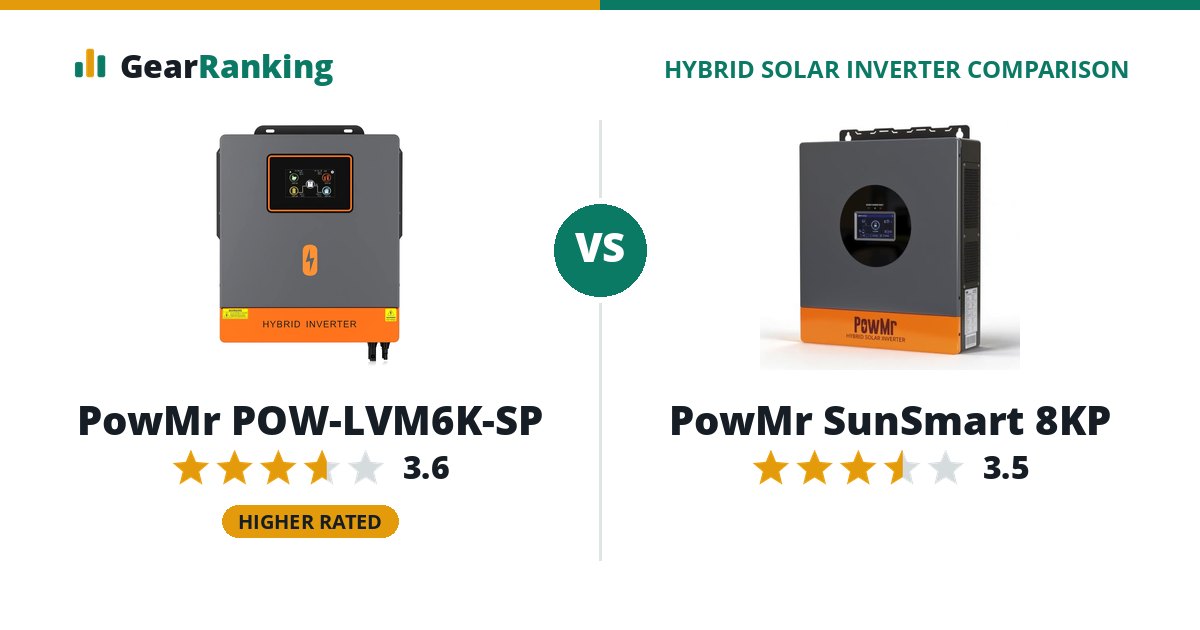
The PowMr POW-LVM6K-SP is the better hybrid solar inverter overall, rated 3.6 to 3.5. The PowMr POW-LVM6K-SP leads on solar input. The PowMr SunSmart 8KP wins on features. The PowMr POW-LVM6K-SP costs $270 less ($549 vs $819).
For budget off-grid builds that need 240 V from a single box. The high idle draw and short warranty are the price of the low cost.
PowMr $549For off-grid homes that want a lot of split-phase power and solar input for little money. Permitted installs that need a UL listing should look elsewhere.
Amazon PowMr $819Prices were last checked October 23, 2026 and are subject to change; the price and availability shown by the retailer at the time of purchase apply.
Each factor is scored 0-100 against the same fixed reference points for every 120/240 V split-phase hybrid solar inverter; a clear win is highlighted. How we rank explains each one.
| Factor weight | PowMr POW-LVM6K-SP | PowMr SunSmart 8KP |
|---|---|---|
| Overall rating | 3.6/5 | 3.5/5 |
| Value 30% | 100 $92 per kW of continuous output | 100 $102 per kW of continuous output |
| Solar input 20% | 68 9,000 W of panels, 500 V max, 2 MPPTs | 51 10,500 W of panels, 500 V max, 1 MPPT |
| Efficiency 20% | 61 94% peak efficiency, 75 W idle | 45 93% peak efficiency |
| Features 15% | 35 Wi-Fi app, battery communication; not UL 1741 listed | 45 Wi-Fi app, parallel stacking, battery communication; not UL 1741 listed |
| Warranty 15% | 0 1-year warranty | 6 1.5-year warranty |
| PowMr POW-LVM6K-SP | PowMr SunSmart 8KP | |
|---|---|---|
| Output | ||
| Output voltage | 120/240 V split-phase | 120/240 V split-phase |
| Continuous output | 6,000 W | 8,000 W |
| Surge | 12,000 W | 16,000 W |
| Peak efficiency | 94% | 93% |
| Idle draw | 75 W | - |
| Transfer time | 10 ms | 10 ms |
| Parallel units | No | Up to 6 units |
| Solar | ||
| Max PV power | 9,000 W | 10,500 W |
| Max PV voltage (Voc) | 500 V | 500 V |
| MPPT range | 80 to 450 V | 125 to 425 V |
| MPPT trackers | 2 | 1 |
| PV current per tracker | 18 A | 27 A |
| Runs without battery | Yes | - |
| Battery and grid | ||
| Battery voltage | 48 V | 48 V |
| Battery types | Lithium, lead-acid, user-defined | Lithium-ion, lead-acid |
| Max charge current | 125 A | 160 A |
| AC charge current | 100 A | 100 A |
| Battery communication | Yes | Yes |
| Grid sell-back | No | No |
| Generator input | - | No |
| UL 1741 | No | No |
| Build | ||
| App monitoring | Included | Included |
| Enclosure | - | IP20 |
| Dimensions | - | 472 x 412 x 130 mm |
| Weight | - | 35.3 lb |
| Warranty | 1 year | 1.5 years |
