The WZRELB 5000W 48V Pure Sine (SEVC) is the better 48V inverter overall, rated 3.2 to 2.7. The WZRELB 5000W 48V Pure Sine (SEVC) leads on value and features. The AIMS Power 5000W 48V Industrial wins on warranty. The WZRELB 5000W 48V Pure Sine (SEVC) costs $795.01 less ($487.99 vs $1,283).
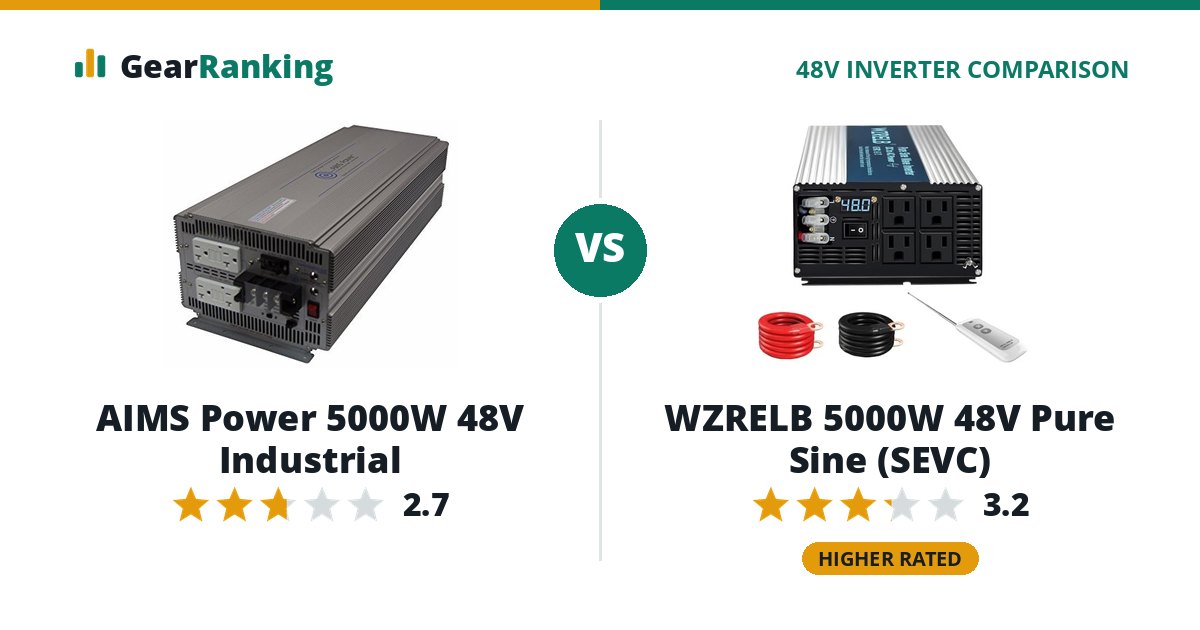
Higher rated

AIMS Power 5000W 48V IndustrialFor an off-grid shop or cabin that needs 5 kW of 120 V from a 48 V bank on a budget and doesn’t need inspection approval. Buyers who want charging or a listing should look at an inverter-charger.
Amazon $1,283 $1,283
Prices were last checked October 24, 2026 and are subject to change; the price and availability shown by the retailer at the time of purchase apply.
Which should you buy?
- Choose the WZRELB 5000W 48V Pure Sine (SEVC) for value ($0.10 per continuous watt vs $0.26 per continuous watt) and features (remote included, hardwire terminal, display; no app vs hardwire terminal; no remote).
- Choose the AIMS Power 5000W 48V Industrial for warranty (2-year warranty vs 1-year warranty).
Scores side by side
Each factor is scored 0-100 against the same fixed reference points for every over 1,500 W 48V inverter; a clear win is highlighted. How we rank explains each one.
| Factor weight | WZRELB 5000W 48V Pure Sine (SEVC) | AIMS Power 5000W 48V Industrial |
|---|
| Overall rating | 3.2/5 | 2.7/5 |
|---|
| Value 30% | 95 $0.10 per continuous watt | 52 $0.26 per continuous watt |
|---|
| Idle draw 15% | 50 idle draw not published (neutral score used) | 53 28.8 W idle with nothing plugged in |
|---|
| Safety listing 15% | 0 no UL 458 or UL 1741 listing stated | 0 no UL 458 or UL 1741 listing stated |
|---|
| Warranty 15% | 0 1-year warranty | 25 2-year warranty |
|---|
| Features 15% | 40 remote included, hardwire terminal, display; no app | 10 hardwire terminal; no remote |
|---|
| Efficiency 10% | 56 90% peak efficiency (maker rating) | 56 90% peak efficiency (maker rating) |
|---|
Specifications
| WZRELB 5000W 48V Pure Sine (SEVC) | AIMS Power 5000W 48V Industrial |
|---|
| Output |
|---|
| Type | Pure sine wave inverter | Pure sine wave inverter |
|---|
| AC output | 120 V | 120 V |
|---|
| Continuous power | 5,000 W | 5,000 W |
|---|
| Surge power | 10,000 W | 10,000 W |
|---|
| DC input range | - | 41 to 60 V |
|---|
| Idle draw | - | 28.8 W (0.6 A at 48 V) |
|---|
| Peak efficiency | 90% | 90% |
|---|
| Connections |
|---|
| AC outlets | 4 | 4 |
|---|
| GFCI outlets | - | Yes |
|---|
| Hardwire terminal | Yes | Yes |
|---|
| USB ports | - | None |
|---|
| Transfer switch | No | No |
|---|
| Parallel units | No | No |
|---|
| Control and build |
|---|
| Remote | Included | No |
|---|
| App | No | No |
|---|
| Display | Yes | No |
|---|
| Safety listing | No | No |
|---|
| Design | - | High-frequency |
|---|
| Cooling | fan | fan |
|---|
| Dimensions | 15.7 x 7.2 x 2.9 in | 23.75 x 8.88 x 6.25 in |
|---|
| Weight | 9.2 lb | 26 lb |
|---|
| Warranty | 1 year | 2 years |
|---|
All 48V inverter comparisons →
