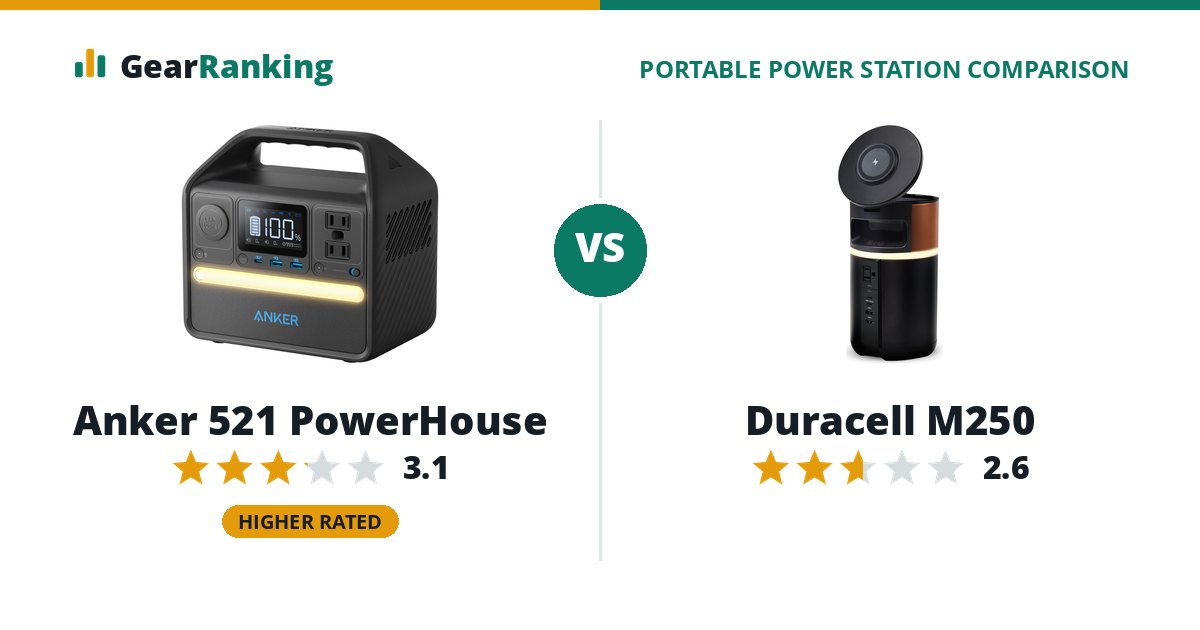
The Anker 521 PowerHouse is the better portable power station overall, rated 3.1 to 2.6. The Anker 521 PowerHouse leads on battery life, AC output and value. The Duracell M250 wins on portability and features. The Duracell M250 costs $10.99 less ($249 vs $259.99).
Higher rated

Duracell M250For people who want a tidy desk or bedside battery for phones and laptops, with wireless charging and a small AC outlet. Anyone who needs to run appliances should buy a conventional power station.
Amazon $249 $249
Prices were last checked October 24, 2026 and are subject to change; the price and availability shown by the retailer at the time of purchase apply.
Which should you buy?
- Choose the Anker 521 PowerHouse for battery life (LiFePO4, 3,000 cycles, 5-year warranty vs Li-ion NMC, 500 cycles, 2-year warranty), AC output (300 W continuous AC vs 100 W continuous AC) and value ($1.02 per rated Wh vs $1.14 per rated Wh).
- Choose the Duracell M250 for portability (107 Wh per kg (4.5 lb (2 kg)) vs 69 Wh per kg (8.2 lb (3.7 kg))) and features (100 W USB-C vs no UPS, expansion or app).
Scores side by side
Each factor is scored 0-100 against the same fixed reference points for every small portable power station; a clear win is highlighted. How we rank explains each one.
| Factor weight | Anker 521 PowerHouse | Duracell M250 |
|---|
| Overall rating | 3.1/5 | 2.6/5 |
|---|
| Value 25% | 51 $1.02 per rated Wh | 40 $1.14 per rated Wh |
|---|
| Tested capacity 15% | 23 75% of rated capacity delivered (1 test) | 50 not yet independently tested (neutral score used) |
|---|
| Battery life 15% | 91 LiFePO4, 3,000 cycles, 5-year warranty | 15 Li-ion NMC, 500 cycles, 2-year warranty |
|---|
| AC output 15% | 41 300 W continuous AC | 0 100 W continuous AC |
|---|
| Charging speed 10% | 50 full AC charge time not published (neutral score used) | 16 0-100% on AC in 3 h 30 min |
|---|
| Portability 10% | 44 69 Wh per kg (8.2 lb (3.7 kg)) | 100 107 Wh per kg (4.5 lb (2 kg)) |
|---|
| Solar input 5% | 12 65 W max solar input | 0 0 W max solar input |
|---|
| Features 5% | 0 no UPS, expansion or app | 20 100 W USB-C |
|---|
Independent capacity tests
Anker 521 PowerHouse
| Tested by | Usable AC energy | Of rated | Conditions |
|---|
| OutdoorGearLab | 192 Wh | 75% | AC output test; load not stated. Measured charging speed 62 Wh/hr (about 4.1 hr full recharge). |
Duracell M250
No independent test published yet.
Specifications
All portable power station comparisons →
