
NeoTamarix CX200+
#1 in HandheldFull review
For buyers who want a 256×192 sensor and long battery life and are willing to bet on a small brand.
AmazonThe NeoTamarix CX200+ is the better thermal camera overall, rated 4.2 to 3.5. The NeoTamarix CX200+ leads on runtime and sensitivity.
Prices were last checked November 27, 2026. Product prices and availability are accurate as of that date and are subject to change; the price and availability shown on Amazon or the retailer's site at the time of purchase apply. As an Amazon Associate we earn from qualifying purchases.
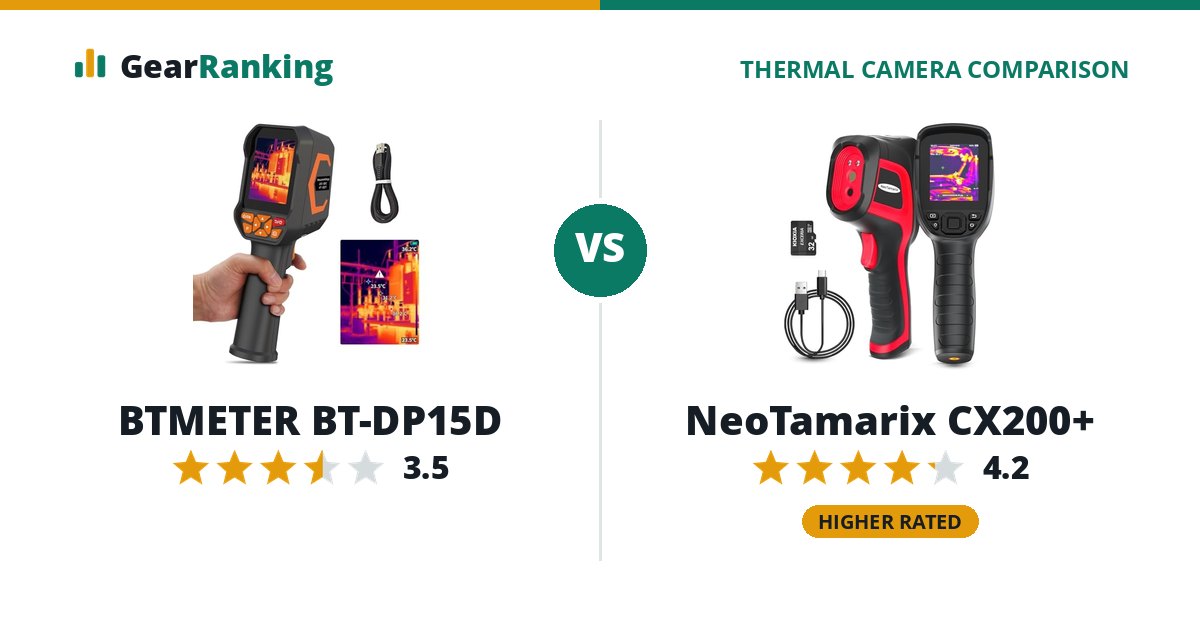
For buyers who want a 256×192 sensor and long battery life and are willing to bet on a small brand.
AmazonOnly the long-range distance reading sets it apart, so most buyers should look elsewhere.
Amazon $359.99Each factor is scored 0-100 against the same fixed reference points for every handheld thermal camera; a clear win is highlighted. How we rank explains each one.
| Factor weight | NeoTamarix CX200+ | BTMETER BT-DP15D |
|---|---|---|
| Overall rating | 4.2/5 | 3.5/5 |
| Resolution 30% | 74 256 x 192 sensor | 74 256 x 192 sensor |
| Value 20% | 50 no current price (neutral score used) | 44 $359.99 |
| Sensitivity 9% | 92 40 mK stated sensitivity | 77 50 mK stated sensitivity |
| Frame rate 8% | 100 25 Hz | 100 25 Hz |
| Accuracy 7% | 86 ±2% stated | 86 ±2% stated |
| Temperature range 5% | 100 reads to 550 °C | 100 reads to 550 °C |
| Visible camera 5% | 100 built-in visible camera | 0 no built-in visible camera listed |
| Durability 6% | 80 IP54, 2 m drop rating | 0 no IP or drop rating published, scored as none |
| Runtime 5% | 100 12 h stated runtime | 20 4 h stated runtime |
| Warranty 5% | 67 2-year warranty | 0 warranty not published, scored as none |
| NeoTamarix CX200+ | BTMETER BT-DP15D | |
|---|---|---|
| Thermal image | ||
| Type | Handheld | Handheld |
| Sensor resolution | 256 x 192 | 256 x 192 |
| Upscaled resolution | 512 x 384 | 512 x 384 |
| Thermal sensitivity (NETD) | 40 mK (Maker: under 40 mK) | 50 mK (Maker: ≤50 mK) |
| Frame rate | 25 Hz | 25 Hz |
| Field of view | 56° x 42° | 56° horizontal |
| Measurement | ||
| Temperature range | -4 to 1,022 °F (-20 to 550 °C) | -4 to 1,022 °F (-20 to 550 °C) |
| Accuracy | ±2% | ±2% |
| Laser pointer | - | Yes |
| Features | ||
| Visible camera | 2 MP | - |
| Storage | 32 GB card included | 8 GB built in |
| Power and build | ||
| Runtime | 12 h (Maker: up to 12 hours) | 4 h (Maker: over 4 hours) |
| Water and dust protection | IP54 | - |
| Drop rating | 2 m | - |
| Warranty | 2 years | - |
