The ELEPHAS H272 Roku TV is the better projector overall, rated 3.2 to 3.0. The ELEPHAS H272 Roku TV leads on streaming. The Dxyiitoo S3 wins on warranty.
Prices were last checked November 9, 2026. Product prices and availability are accurate as of that date and are subject to change; the price and availability shown on Amazon or the retailer's site at the time of purchase apply. As an Amazon Associate we earn from qualifying purchases. As an eBay Partner, we may be compensated if you make a purchase.
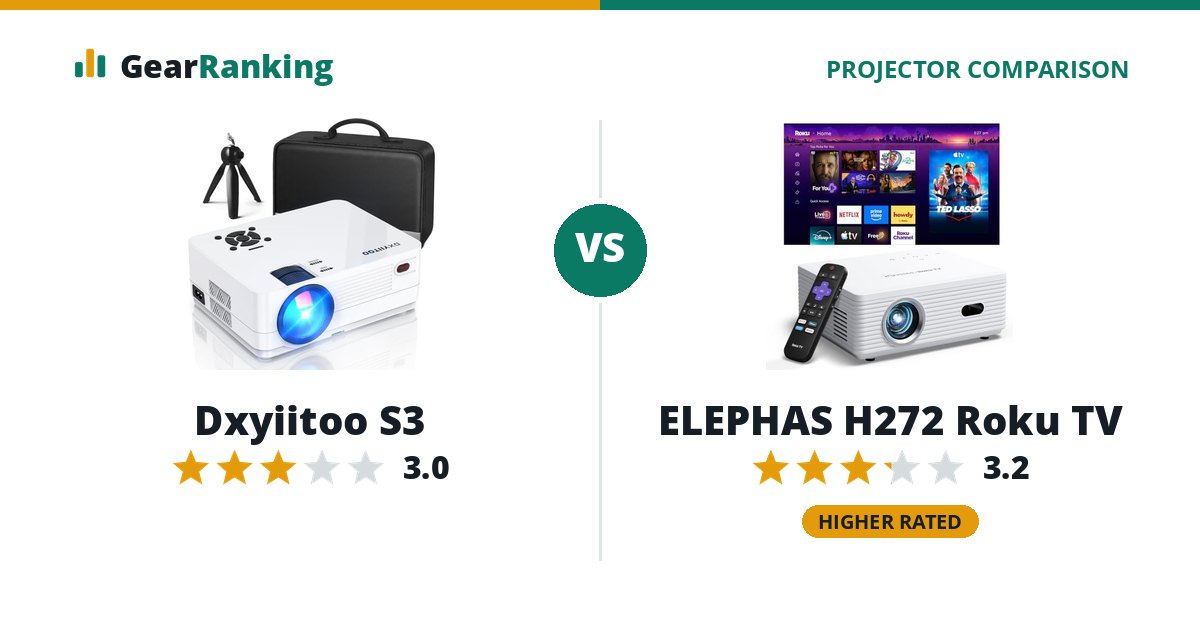
Higher rated
ELEPHAS H272 Roku TVA small Roku TV projector with a native 1080p panel and automatic setup, for streaming in a dark bedroom. ELEPHAS publishes no brightness rating, so expect a picture sized for a dim room.
Amazon $129.99 eBay $129.99

Dxyiitoo S3A plug-in native 1080p projector for movie nights with a streaming stick. Without a brightness rating it is hard to judge against rated models in its price range.
Amazon $129.98 eBay $129.98
Which should you buy?
- Choose the ELEPHAS H272 Roku TV for streaming (Roku TV with licensed Netflix vs no built-in apps; needs a streaming stick).
- Choose the Dxyiitoo S3 for warranty (3-year warranty vs 1-year warranty).
Scores side by side
Each factor is scored 0-100 against the same fixed reference points for every native 1080p projector; a clear win is highlighted. How we rank explains each one.
| Factor weight | ELEPHAS H272 Roku TV | Dxyiitoo S3 |
|---|
| Overall rating | 3.2/5 | 3.0/5 |
|---|
| Brightness 25% | 0 no ANSI or ISO brightness rating | 0 no ANSI or ISO brightness rating |
|---|
| Value 15% | 50 no rated brightness (neutral score used) | 50 no rated brightness (neutral score used) |
|---|
| Resolution 10% | 100 1920 x 1080 native | 100 1920 x 1080 native |
|---|
| Streaming 15% | 100 Roku TV with licensed Netflix | 0 no built-in apps; needs a streaming stick |
|---|
| Setup 10% | 60 Autofocus, auto keystone | 50 setup features not stated (neutral score used) |
|---|
| Light life 10% | 50 light source life not published (neutral score used) | 100 100,000 hour LED |
|---|
| Gaming 10% | 50 input lag not published (neutral score used) | 50 input lag not published (neutral score used) |
|---|
| Warranty 5% | 0 1-year warranty | 100 3-year warranty |
|---|
Specifications
| ELEPHAS H272 Roku TV | Dxyiitoo S3 |
|---|
| Picture |
|---|
| Native resolution | 1920 x 1080 (1080p) | 1920 x 1080 (1080p) |
|---|
| Picture resolution | 1080p | 1080p |
|---|
| Display | - | LCD |
|---|
| Light source | - | LED |
|---|
| Light source life | - | 100,000 hours |
|---|
| Dynamic contrast | - | 10,000:1 |
|---|
| Placement |
|---|
| Throw | - | Standard throw |
|---|
| Largest image | 150 in | 300 in |
|---|
| Autofocus | Yes | - |
|---|
| Auto keystone | Yes | - |
|---|
| Streaming and gaming |
|---|
| Built-in apps | Roku TV, licensed Netflix | None |
|---|
| Build |
|---|
| Battery | None | None |
|---|
| Dimensions | - | 9.25 x 6.61 x 3.27 in |
|---|
| Weight | - | 2.9 lb |
|---|
| Warranty | 1 years | 3 years |
|---|
| Released | 2026-10 | - |
|---|
All projector comparisons →