
Thermal Master P1
#7 in SmartphoneFull review
The best-documented cheap phone camera here, for casual home checks.
Amazon $103.20$103.20
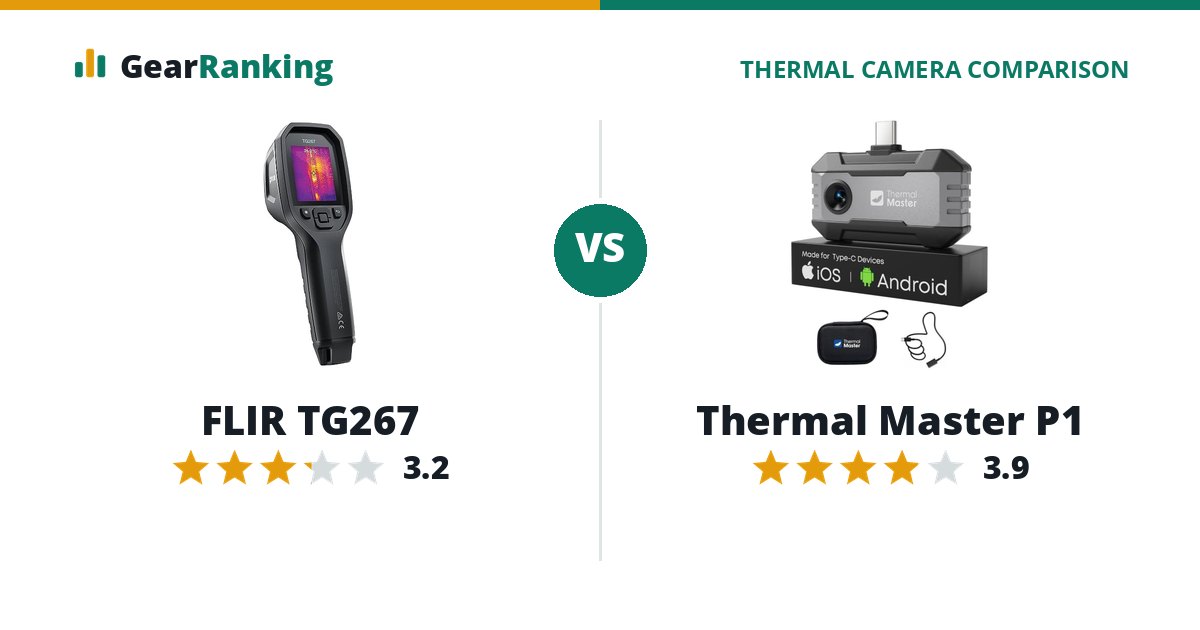
The Thermal Master P1 rates 3.9 among smartphone thermal cameras; the FLIR TG267 rates 3.2 among handheld ones.
Prices were last checked November 27, 2026. Product prices and availability are accurate as of that date and are subject to change; the price and availability shown on Amazon or the retailer's site at the time of purchase apply. As an Amazon Associate we earn from qualifying purchases.
The best-documented cheap phone camera here, for casual home checks.
Amazon $103.20A jobsite tool for electricians and HVAC techs who want FLIR’s grip-style design and a longer detector warranty.
AmazonThese two sit in different type classes (smartphone and handheld), and each is scored against the reference points for its own class, so a rating says how well each does among its own type peers. How we rank explains each factor.
| Factor weight | Thermal Master P1 | FLIR TG267 |
|---|---|---|
| Overall rating | 3.9/5 | 3.2/5 |
| Resolution 32% | 44 160 x 120 sensor | 44 160 x 120 sensor |
| Value 21% | 83 $103.20 | 50 no current price (neutral score used) |
| Sensitivity 9% | 92 40 mK stated sensitivity | 46 70 mK stated sensitivity |
| Frame rate 8% | 100 25 Hz | 0 8.7 Hz |
| Accuracy 7% | 86 ±2 °C stated | 50 accuracy not published (neutral score used) |
| Temperature range 5% | 100 reads to 600 °C | 76 reads to 380 °C |
| Visible camera 5% | 0 no built-in visible camera listed | 100 built-in visible camera |
| Durability 6% | 55 IP54, 1 m drop rating | 80 IP54, 2 m drop rating |
| Warranty 5% | 67 2-year warranty | 67 2-year warranty |
| Runtime 5% | Not scored | 30 5 h stated runtime |
| Thermal Master P1 | FLIR TG267 | |
|---|---|---|
| Thermal image | ||
| Type | For a phone | Handheld |
| Sensor resolution | 160 x 120 | 160 x 120 |
| Upscaled resolution | 320 x 240 | - |
| Thermal sensitivity (NETD) | 40 mK | 70 mK (Datasheet: under 70 mK) |
| Frame rate | 25 Hz | 8.7 Hz |
| Field of view | 52° x 39° | 57° x 44° |
| Measurement | ||
| Temperature range | -4 to 1,112 °F (-20 to 600 °C) | -13 to 716 °F (-25 to 380 °C) |
| Accuracy | ±2 °C | - |
| Laser pointer | - | Yes |
| Features | ||
| Visible camera | - | 2 MP |
| Screen | - | 2.4 in |
| Connection | USB-C | - |
| Works with | Android, USB-C iPhone, Windows | - |
| Power and build | ||
| Runtime | - | 5 h (4.5 hours with the laser on) |
| Water and dust protection | IP54 | IP54 |
| Drop rating | 1 m | 2 m |
| Weight | 17 g | 394 g |
| Warranty | 2 years | 2 years (Maker also covers the detector for 10 years) |
